
Introduction: A Voice That Became Global
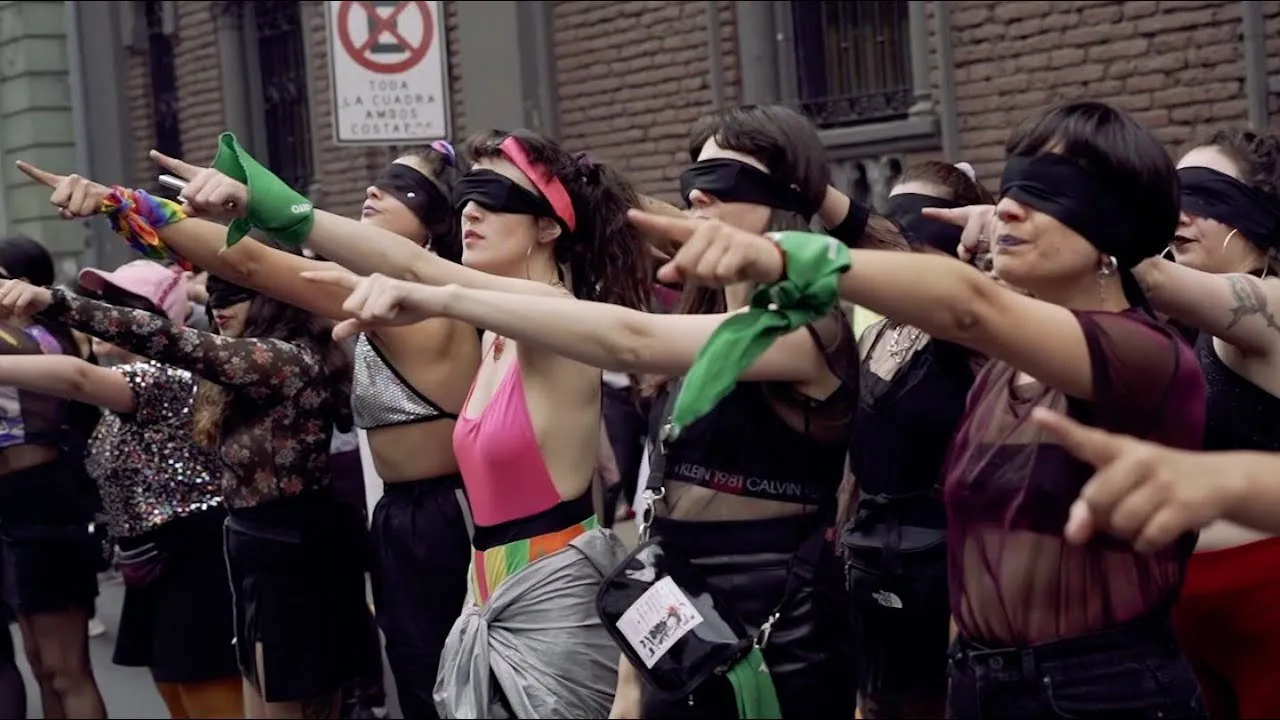
When on November 25, 2019, coinciding with the International Day for the Elimination of Violence against Women, the Chilean feminist group Las Tesis launched a protest performance in the streets of Santiago, no one imagined that this artistic-political action would become a global phenomenon. The performance, titled Un violador en tu camino (A Rapist on Your Way), was held in front of institutions of power including the Ministry of Women and Gender Equality, and in it the patriarchal system, the state, the police, and the judiciary were directly addressed as the main agents responsible for the continuation of gendered oppression.
What followed was a global explosion. The performance spread with astonishing speed from the streets of Chile to all over Latin America, Europe, the Middle East, and Asia. By 2021, it had been re-performed in over 400 locations in more than 50 countries worldwide, including in the Turkish Parliament, where deputies, in protest of the arrest of activists, performed this anthem [1]. This wave eventually reached Iran as well.
But what made this artistic performance so powerful and pervasive? How does this phenomenon answer the fundamental question “Why can art still be alive?”
1. Theoretical and Political Roots: “Thesis” Behind Las Tesis
The name Las Tesis (meaning “the theses”) is no coincidence. The group consists of four feminist artists from the city of Valparaíso, Chile, who have made it their main goal to “translate” academic feminist theories into the language of art and street action.
a) Political Background: The Chilean Social Uprising. This performance did not emerge in a vacuum. It was born in the midst of the widespread social protests in Chile (Estallido Social) in October and November 2019 against the government of Sebastián Piñera and deep economic and social inequalities [2]. It was a direct response to numerous reports of systematic sexual violence by the police forces (Carabineros) against detained protesters [3].
b) Theoretical Framework:
• Rita Segato: The core of the performance is a direct translation of the theory of Argentine feminist anthropologist Rita Segato. In her book Las Estructuras Elementales de la Violencia, Segato argues that rape is not an individual sexual motive or a “minor crime”, but a “socio-political and structural event” and a political act to exert domination and power, supported by institutions [4].
• Silvia Federici: Another inspiration for the group is the work of Silvia Federici and her book Caliban and the Witch: Women, the Body and Primitive Accumulation, which reveals the link between patriarchy, primitive accumulation of capital, and the exploitation of women’s bodies [5].
2. Anatomy of the Performance: The Politics of Bodies
The performance “Un violador en tu camino” is an act of artivism (art + activism) that converts feminist theory into embodied knowledge [6]. Here, the bodies are not merely carriers of a message; they are the message.
a) Chant Lyrics: A Manifesto of Accusation. The lyrics of the chant are explicit and, like a manifesto, invert the direction of blame:
• “El patriarcado es un juez / que no juzga por nacer.”
• “Y la culpa no era mía / ni dónde estaba / ni cómo vestía.”
• “El violador eres tú / los pacos / los jueces / el estado / el presidente.”
This is a direct institutional critique.
b) Parody as a Weapon. The performance’s title itself is a sarcastic play on the Chilean police (Carabineros) slogan of the 1990s, which was Un amigo en tu camino (“A friend on your path”) [8]. Moreover, the melody and part of the lyrics are adapted from an old traditional police hymn, in order to highlight the contrast between the state’s promise of security and the reality of institutionalized violence.
c) Political Choreography: Reclaiming the Body. The movements in this performance are not random:
• Blindfolds: This element is multilayered. It is both a symbol of “blind justice” and a direct reference to state violence in the 2019 Chilean uprising (the blinding of protesters) [3], and also a reminder of the Pinochet-era torture center called La Venda Sexy [9].
• Squatting: This is the most powerful element of the performance. This movement is the “re-appropriation” of a humiliating act of political-sexual torture that the police (Carabineros) used to force detained women to perform naked [10]. Las Tesis turned this symbol of individual humiliation into a symbol of collective resistance.
• Pointing Finger: This movement reverses the direction of blame, pointing the finger of accusation directly at the institutions of power.
d) Theoretical-Aesthetic Layer: From Representation to Presence. In the Las Tesis performance, language becomes body, and body becomes language. Judith Butler, in Notes Toward a Performative Theory of Assembly, says that the very “gathering of bodies” in public space is a kind of political speech; even before a single word is uttered, the mere collective presence of bodies is a meaningful act [11]. The bodies that are blindfolded and singing in unison express two things: a shared experience of trauma, and a collective will to recreate power. Here the effect moves from the level of representation to the level of presence. Art normally
shows something; but here social reality is unfolding itself. There is no audience; anyone who sees is potentially part of the performance. In this situation, the performance is no longer “art about protest”, but “protest as art.”
3. Replication Engine: Form as a Weapon
The replicability of this performance reflects the smart choices of its designers.
• Simplicity and Accessibility:
o Form (chant/song): The chant that the crowd shouts unites individual bodies into a single body. The chants are short to be memorable and rhythmic to make bodies move in a collective dance. Las Tesis used this form—a catchy statement that could be another voice.
o Time: The performance lasts about one minute, making it ideal for learning and sharing on social media.
o Place: The performance takes place in the “street,” a democratic and free space, bringing art out of the monopoly of museums.
• Translatability and Localization:
o The text is simple and devoid of complex metaphors.
o This performance was translated and performed in indigenous languages such as Mapudungun (by Mapuche women in Chile) and Quechua (in Peru) [12]. In India, the performance was adapted to address sexual crimes based on the caste system [13].
• Universal Content:
o This chant addresses a shared experience that almost all women in the world have lived through in different forms. This “shared global experience” caused instant empathy and a desire to re-perform it.
• Structural Independence:
o Most importantly, this art needs no sponsor, buyer, producer, or investor. Art that attaches itself to demonstrations does not fall into the trap of the official art economy. This independence is itself part of its radical message.
4. Activating Memory: the “Las Tesis Senior” Version and Surplus Discourses
The significance of this performance doubled when the Las Tesis Senior version was performed on December 4, 2019. About 10,000 older women performed this piece in front of the National Stadium (Estadio Nacional) in Santiago. This venue was a notorious center for detention, torture, and rape of political prisoners during Augusto Pinochet’s dictatorship [14].
a) Surplus Discourses (Discursos que exceden). Critical discourse analysis showed that the narratives of the participants reflected, beyond the condemnation of sexual-political violence, six main discourses [15]:
1. Representing the Uncountables: The sense of responsibility to represent women who cannot be present (those with disabilities, Black women, or deceased ancestors).
2. Age Non-Identification: Redefining age identities and fighting against exclusions based on age.
3. Memory and the Past: The performance at the National Stadium activated the discourse of memory and connected the political violence of the dictatorship era to the current violence in the streets.
4. Fear and Catharsis: Transforming the fear of unsafe public spaces into resistance; this act was described as a “ritual” or “collective catharsis” that provided an opportunity to release accumulated anger, shame, and pain.
5. Transgenerational Violence: Participation as a “generational responsibility” to stop the cycles of past violence (mothers and grandmothers).
6. The Body in Action: The collective movement in public space, beyond a dance, was a reclaiming of control over the body and an expression of freedom.
b) Intersectionality and Re-signification of Vulnerable Identities. This action used the concept of “intersectionality as a situation” (Interseccionalidad como situación) [16]. This approach analyzes how classifications of identity (such as age, class, or health status) create vulnerabilities that can then be turned into a force of resistance. This action was able to transform individual vulnerabilities into a driving force for collective political action. For example [15]:
• Patriarchal Construction of Woman: Women who had fought for generations for their daughters’ financial independence to protect them from intimate partner violence saw their participation as a continuation of that very struggle.
• Illness and Care: Women who participated in the performance despite physical limitations or caregiving obligations (caring for patients) transformed their identity as “caregivers” or “women with illness” into a political force for claiming rights.
5. Global Context: Decolonizing Activism
a) Difference from #MeToo. The global spread of “Un violador en tu camino” helped challenge the neocolonial power structures within social movements. Rita Segato believes that #MeToo (rooted in North American Puritan feminism) is individualistic and seeks the state as the ultimate arbiter for justice, whereas Ni Una Menos and Un violador directly criticize society and the state as the agents of structural violence [17].
b) The Ambivalent Role of Digital Media. The role of digital media (Twitter, Instagram, YouTube) in spreading this movement was very prominent but highly ambivalent [18]:
• Advantages: Rapid and global dissemination [19], content management (such as SoundCloud for the instrumental track) [20], and political access (the action reaching the Turkish parliament) [21].
• Limitations:
o Digital Divide: Access to digital tools is itself a privilege, influenced by geography, income, education, and age [22].
o Patriarchal Online Space: The online sphere provided a platform for the continuation of misogyny, hate speech, and mockery of the performance [23].
o Algorithmic Bias: Algorithms tend to give more visibility and support to women who fit the “platform norms” (such as being white, middle-class) [24].
c) Legacy and Legal Challenges. This collective was included in TIME magazine’s list of the 100 Most Influential People of 2020 [25] and received awards such as the “Jimmy Castillo Velasco” Human Rights Award and the UK Design of the Year Award. The power of this performance was such that after the release of a joint video with the Russian collective Pussy Riot [26] against police violence, the Carabineros (Chilean police) filed an official complaint against Las Tesis for “incitement to violence”. The police claimed that they felt intimidated by this action. Ultimately, in January 2021, the court dismissed the case and emphasized the artistic nature of the work [27].
Conclusion: The Aliveness of Art and the Potential for Action
The question “Why can art still be alive?” on a seemingly historical or sociological level refers to the power of influence and replication, but at its core, it is an ontological question: what allows art to live? In the contemporary world where art is often frozen as a cultural commodity in museums and galleries, being alive means having agency: the ability to act, intervene, and alter the fabric of the real world. The Las Tesis piece is alive for this reason, because it moves on the border between symbol and reality; from language to body, from body to collective, and from collective to the public sphere.
As Hannah Arendt would say, this performance goes beyond the realm of “work” (which makes things) and “production” (which has a product) and enters the realm of action—a space where humans appear together in the shared world, on a political stage that gains meaning from their presence. In this sense, art is alive because it can still appear, it can still rescue the world from silence.
Jacques Rancière also calls this aliveness “the aesthetics of politics”: the power of art to shift the boundary between what is seen and heard and what is suppressed. The Las Tesis performance exactly removes this boundary—it declares, “We are not victims, we are voices,” and thus reconfigures the structure of listening. Las Tesis is not just about survival, but about the possibility of equal living or “livability” [11]. The Las Tesis performance, by creating a scene where marginalized bodies occupy space with their own voice and movement, creates a moment of reclaimed livability. This performance is not merely a critique of violence, but a practical exercise of freedom.
In the end, the aliveness of art means its ability to enter social life—the ability to get “infected” by the real world and at the same time save the world from silence. This “infection” is the condition of survival: art that does not touch the world soon becomes a mummy of beauty.
Footnotes:
[1] Martin, D., & Shaw, D. (2021). “Chilean and Transnational Performances of Disobedience: Las Tesis and the Phenomenon of Un violador en tu camino.” Bulletin of Latin American Research, 40(5), 712–729. (Also BBC News Mundo (2019) for coverage of the Turkish parliament performance). [2] Castells, M. (2015). Networks of Outrage and Hope: Social Movements in the Internet Age. Polity Press. (For the theoretical background of social protests). [3] Human Rights Watch. “Chile: Police Reforms Needed in the Wake of Protests.” (Report on police violence and eye injuries in the 2019 uprising). [4] Segato, Rita Laura. (2003). Las Estructuras Elementales de la Violencia. (Also Segato, R. (2018). Contra-pedagogías de la crueldad). [5] Federici, Silvia. (2004). Caliban and the Witch: Women, the Body and Primitive Accumulation. Autonomedia. [6] Taylor, Diana. Performance. (For a theoretical analysis of performance as the transfer of knowledge through the body). [7] Serafini, P. (2020). “A rapist in your path: Transnational feminist protest and why (and how) performance matters.” European Journal of Cultural Studies, 23(2). [8] Huenchumil, P. (2019). “Las mujeres chilenas detrás de la performance ‘Un violador en tu camino’.” Interferencia.cl. [9] Martin, D., & Shaw, D. (2021). (This article refers to the historical and symbolic connections of the performance with the dictatorship era). [10] Burdiles, N. (2020). Comunicación Feminista y Arte Performático: El Proyecto Político del Colectivo LasTesis. Revista Nomadías, 29. [11] Butler, Judith. Notes Toward a Performative Theory of Assembly. (Also Butler, J. (2006). Undoing Gender. Paidós). (For analysis of “the gathering of bodies” and “livability”). [12] Gutierrez, Mariana. (2019). “Crean versión en quechua de ‘Un violador en tu camino’.” SDPNoticias.com. [13] Cuffe, Sandra. (2019). “Chile’s ‘A Rapist in Your Path’ Chant Hits 200 Cities: Map.” Al Jazeera. [14] Bieletto-Bueno, N. (2020). “Sonido, vocalidad y el espacio de audibilidad pública. El caso de la performance ‘Un violador en tu camino’ por Las Tesis Senior...” (Analysis of the Senior version performance at the National Stadium). [15] Jiménez Concha, Susan. (Thesis). Analysis of the feminist political action “LasTesis Senior”. (Main source of analysis for “surplus discourses” and “re-signification of vulnerable identities”). [16] Crenshaw, K. (1991). Mapping the Margins: Intersectionality... (Main theoretical source for “intersectionality as situation”). [17] Segato, Rita Laura. (2018). Contra-pedagogías de la crueldad. (Includes Segato’s analyses critiquing individualistic approaches such as #MeToo). [18] Stielow, Julia Marie. (Thesis). “The Role of Digital Media in the Spread of Un violador en tu camino.” (Main source of analysis on the “ambivalent” role of digital media). [19] Valenzuela Sebastián, et al. (2012). “The social media basis of youth protest behavior: the case of Chile.” Journal of Communication. [20] Colectivo LASTESIS. (2020). “LASTESIS – el violador eres tú [instrumental].” SoundCloud. [21] BBC News Mundo. (2019). “‘Un violador en tu camino’ de Las Tesis... la policía en
Turquía reprime una representación...” [22] Kidd, D., & McIntosh, K. (2016). “Social media and social movements.” Sociology Compass. [23] Stielow, J. M. (Thesis). (Analysis of the patriarchal online space). [24] Stielow, J. M. (Thesis). (Analysis of algorithmic bias). [25] TIME Magazine. (2020). “The 100 Most Influential People of 2020.” [26] Las Tesis and Pussy Riot. (2020). “Manifesto against Police Violence.” (YouTube video). [27] (Source: las tesis_info.docx). (Fact-based reports on the legal challenge and dismissal of the case by the court).